Franchising loves growth.
More units. More territories. More systemwide sales. More openings. More franchise agreements signed.
And there is plenty of growth to celebrate. According to the International Franchise Association’s 2026 Franchising Economic Outlook, franchising is projected to reach approximately 845,000 establishments in the United States this year, generating $921.4 billion in economic output.1
Those are impressive numbers.
But there is another number I would like to see alongside them:
How many franchisees are actually building healthy, sustainable businesses?
Because selling another franchise and building a franchise system capable of producing successful operators are not the same thing.
We Measure What We Want to Grow
Franchise development has become increasingly sophisticated.
We measure leads, discovery days, conversion rates, territories awarded, agreements signed and locations opened. We know our pipeline and how many franchises we expect to sell.
Once the franchisee opens, however, our definition of success often changes.
Now we talk about revenue, average unit volume, systemwide sales and year-over-year growth.
Those numbers matter. But none of them, by themselves, tell us whether the franchisee has built a healthy business.
A franchisee can grow revenue and still struggle with cash. A location can produce respectable sales and still generate an unacceptable return on the owner’s investment. A system can grow while individual operators struggle with labor, marketing expense, working capital and shrinking margins.
Top-line growth can hide a lot underneath it.
The industry appears increasingly focused on this issue. In the International Franchise Association’s 2025 Annual Franchisor Survey, 42% of franchisor executives identified unit economics as the single most important factor affecting the franchisor-franchisee relationship.2
Eventually, the economics become the relationship.
Franchise Development Has Changed, Too
There was a time when much of franchise development was relatively direct.
A prospective owner became interested in a brand or category, contacted the franchisor, learned about the business and decided whether to move forward.
That still happens. But today’s development ecosystem is far more complex.
A prospective entrepreneur may start simply with: I want to own a franchise.
From there, they may enter a broker network, be introduced to multiple concepts, move through an outsourced franchise sales organization and eventually arrive at the franchisor.
Brokers and FSOs can provide tremendous value, particularly to emerging brands that don’t yet have the reach or infrastructure to build a sophisticated development function internally.
But their growth introduces an important question: Are all of the participants in franchise development measuring success the same way?
A broker may measure a successful placement. An FSO may measure franchises sold. The franchisor may measure units opened.
But the most important outcome may not be known for several years: Did this person build a successful business?
By then, the development transaction is long over. The franchisor, however, is still in the relationship.
What Is the Franchisee Actually Trying to Build?
That raises another question we sometimes overlook: What did the owner want the business to accomplish in the first place?
When I was with Neighborly, new franchise owners participated in a program created by Dina Dwyer-Owens called Design Your Life. Owners were encouraged to think beyond a revenue target and define what they wanted their lives to look like—and how the business they were building would help them get there.3
I always thought there was something powerful about that.
One owner may want to build a multi-unit organization. Another may want to build a strong local company, develop management and eventually step away from day-to-day operations. Another may be building an asset they intend to sell.
The destination matters.
If you know what you’re trying to build—and ultimately how you want to exit it—the decisions you make along the way become much more intentional.
Perhaps that gives us a better definition of franchisee success.
Success isn’t simply hitting an average unit volume. It’s building the business the owner intended to build when they entered the system.
The franchisor can’t do that work for them. But a strong franchise system should materially improve the probability that a capable owner who executes the model can get there.
What Are We Actually Trying to Grow?
A franchise sale matters. A territory awarded matters. An opening matters.
But they are milestones—not outcomes. The outcome comes later.
Did the franchisee build a healthy business? Did they renew? Did they expand? Would they make the investment again?
And, importantly: What did the franchisor learn from the franchisees who succeeded—and from the ones who didn’t?
That knowledge should flow back to the beginning.
It should improve the ideal franchisee profile. It should influence capitalization requirements and market selection. It should inform what brokers look for and how an FSO qualifies candidates.
An emerging franchisor may need brokers to create reach. It may need an FSO to provide capabilities it doesn’t yet possess. Those may be exactly the right choices at that stage.
But as the system grows, the franchisor should be developing something increasingly valuable: institutional knowledge about who succeeds in its system and why.
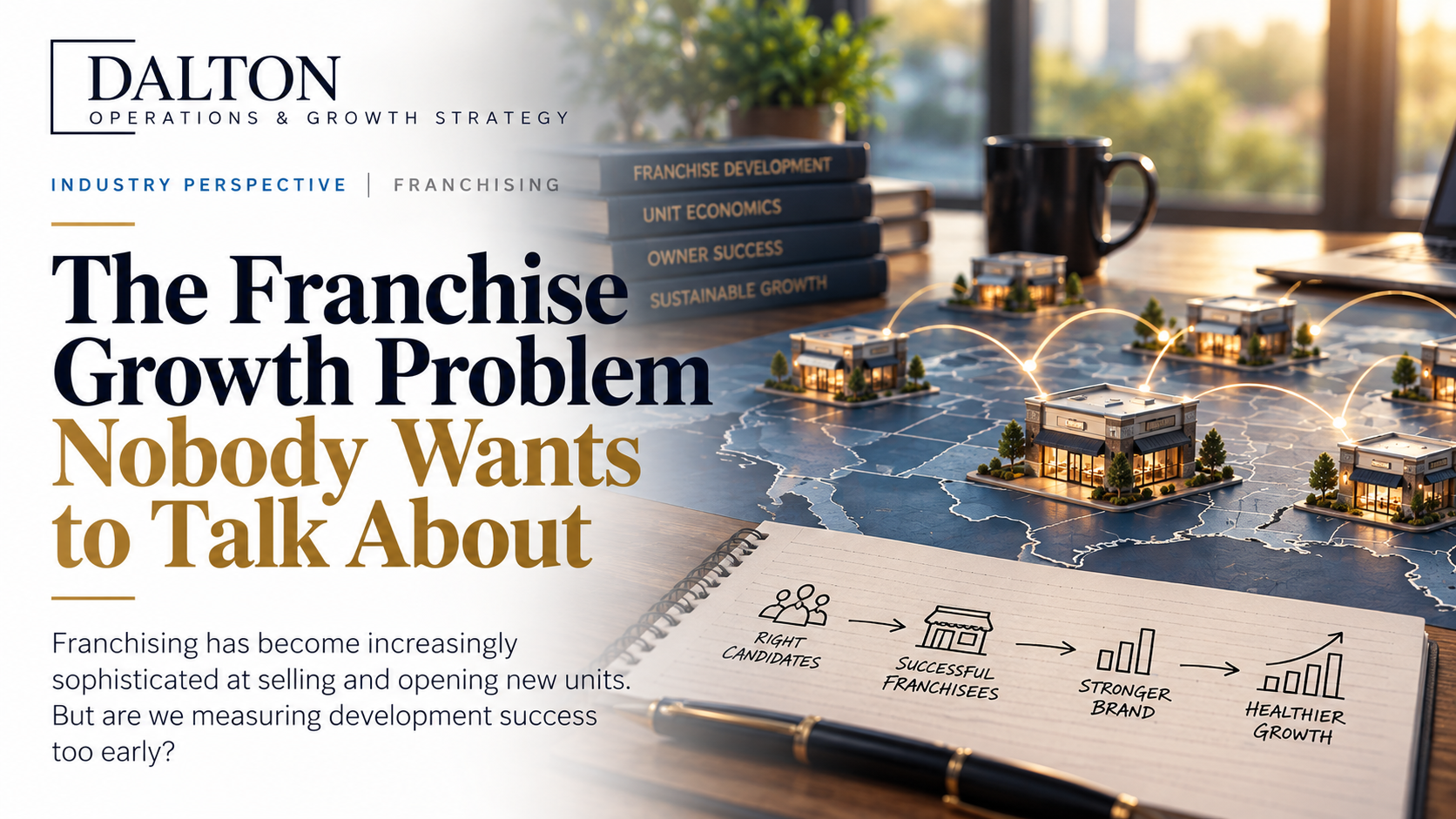
That knowledge should create better candidate selection. Better selection should create healthier franchisees. Healthier franchisees should improve validation. Better validation should attract stronger candidates.
Growth should create better growth.
Maybe We’re Measuring Growth Too Early
Perhaps that’s the fundamental issue.
We tend to declare franchise-development success at the beginning of the relationship: We sold the franchise.
But the more meaningful evidence arrives years later.
So perhaps the most important question isn’t: How quickly can we sell franchises?
It’s: How consistently can we identify the right people, put them into a system capable of supporting their success, and learn from the results?
Because one measures how effectively we can sell a franchise system.
The other measures whether we’ve built one worth growing.
Sources
- International Franchise Association, 2026 Franchising Economic Outlook, conducted by FRANdata.
- International Franchise Association and FRANdata, 2025 Annual Franchisor Survey.
- Dina Dwyer-Owens, Your Better Future, December 18, 2017.
Build growth that gets stronger as it scales.
If you’re thinking about franchisee performance, development strategy or the operating systems required to scale, let’s talk.
Start a conversation